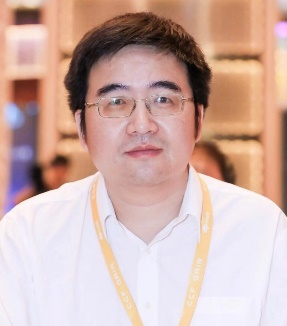
Associate Professor
School of Architecture, Tsinghua University
E-mail: yangtao128@tsinghua.edu.cn
Profile
Tao Yang is an Associate Professor in the School of Architecture at Tsinghua University and an Associate Researcher in the Brain-Inspired Intelligence Group at the Beijing National Research Center for Information Science and Technology, Tsinghua University. His research focuses on spatiotemporal intelligence. He has led a work package under the Ministry of Science and Technology's international research cooperation programme, a General Programme project funded by the National Natural Science Foundation of China, and an EPSRC-supported interdisciplinary knowledge transfer project in the UK.
His major projects include the Xiong'an planning and construction BIM platform, detailed planning for the initial administrative district of Beijing's sub-centre, large models for intelligent urban regeneration decision-making, the Suzhou CIM platform, BIM for important existing buildings in Shenzhen, a corpus and knowledge base for spatially intelligent design, and simulation based on urban regeneration patterns.
He has published more than 200 papers and holds nine patents. His professional roles include Deputy Chair of the Digital Twins and Future Cities Committee and the Construction Internet and BIM Committee of the Chinese Society for Urban Studies, Deputy Director of the Technology Innovation Centre for Smart Human Settlements and Spatial Planning Governance, and Deputy Editor-in-Chief of Urban Design. His awards include the Natural Resources Science and Technology Award, the Huaxia Construction Science and Technology Award, and the National Geospatial Industry Gold Award for Outstanding Engineering Projects.
Research and Teaching Interests
Large models for spatiotemporal intelligence; AI cities; digital twin cities; city information modelling (CIM); building information modelling (BIM); space syntax.
Education
PhD, Tsinghua University, 2018.
PhD, University College London, 2019.
MArch, Tsinghua University, 2002.
BArch, Tsinghua University, 1999.
Professional Experience
2022–present. Associate Professor, School of Architecture, Tsinghua University.
2017–2022. Executive Deputy Director, Future City Laboratory, and Chief Architect, Xiong'an Research Institute, China Academy of Urban Planning & Design (CAUPD).
2015–2017. Deputy Chief Architect and Deputy Director of the Planning and Design Department, Beijing Institute of Architectural Design (BIAD).
2013–2015. Associate Researcher, Urban and Rural Planning Management Centre, Ministry of Housing and Urban-Rural Development (MOHURD).
2011–2012. Research Consultant and Associate, Space Syntax Limited, UCL.
2010–2011. Research Associate, The Bartlett, University College London (UCL).
2007–2010. Research Assistant, The Bartlett, UCL.
2006–2007. Project Consultant, Space Syntax Limited, and Honorary Research Assistant, UCL.
2002–2003. Project Manager, China Yintai Investment Limited.
Academic and Professional Service
2026–present. Associate Researcher, Brain-Inspired Intelligence Group, Beijing National Research Center for Information Science and Technology, Tsinghua University.
2024–present. Deputy Chair, Construction Internet and BIM Committee, Chinese Society for Urban Studies.
2023–present. Instructor, National Academy for Mayors of China.
Digital Twins and Future Cities Committee, Chinese Society for Urban Studies: Executive Deputy Secretary-General (2024–present); Deputy Chair (2023–present); Member (2021–present).
2023–present. Deputy Director, Technology Innovation Centre for Smart Human Settlements and Spatial Planning Governance, Ministry of Natural Resources.
2022–present. Young Editorial Board Member for Civil, Hydraulic and Architectural Engineering, Engineering, Chinese Academy of Engineering.
2022–present. Expert Adviser, Digital Twin Technology Applications Working Committee, Internet Society of China.
2022–present. Editorial Board Member, Urban Data, Science & Technology.
2021–present. Expert Member, Urban Infrastructure Operations Monitoring Expert Group, MOHURD.
2021–present. Expert Member, New Urban Infrastructure Development Expert Group, MOHURD.
2021–present. Member, Smart City Working Committee, Chinese Society for Geodesy, Photogrammetry and Cartography.
2019–present. Member, Architectural Programming and Post-Occupancy Evaluation Committee, Architectural Society of China.
2019–present. Expert Member, Cybersecurity and Informatization Expert Group, MOHURD.
2019–present. Standing Council Member, Computational Design Academic Committee, Architectural Society of China.
2018–present. Editorial Board Member, Art & Design Review.
2018–present. Member, Big Data Committee, Chinese Society for Urban Studies.
2018–present. Member, International Space Syntax Steering Committee.
2018–present. Council Member, Urban Design Branch, Architectural Society of China.
2015–present. Deputy Editor-in-Chief, Urban Design, Tsinghua University.
Honours and Awards
2026. Second Prize, National Geospatial Science and Technology Progress Award, for key technologies and applications in cross-sector 3D scene reconstruction and digital and intelligent simulation in megacities (contributor rank: 1 of 12).
2026. Second Prize, National Geospatial Science and Technology Progress Award, for key digital and intelligent technologies and applications in the conservation and use of urban and rural historical and cultural heritage (contributor rank: 3 of 12).
2025. Second Prize, Natural Resources Science and Technology Award, for digital and intelligent territorial spatial planning and governance technologies in urbanised areas (contributor rank: 2 of 15).
2025. Second Prize, Huaxia Construction Science and Technology Award, for intelligent technologies for updating BIM throughout the use phase of existing buildings (contributor rank: 1 of 12).
2024. National Geospatial Industry Gold Award for Outstanding Engineering Projects, for BIM of existing buildings in Shenzhen (contributor rank: 2 of 15).
2024. First-ranked nomination for the Qian Xuesen Urban Studies Gold Award in Cultural Heritage, for the digital twin of Suzhou's historic city (contributor rank: 1 of 6).
2024. Smart City Pioneer List, Elite Professional recognition.
2023. Third Prize, Guangdong Outstanding Urban Planning and Design Award, for Shenzhen Mawan.
2023. National Geospatial Industry Gold Award for Outstanding Engineering Projects, for the Suzhou CIM platform (contributor rank: 4 of 15).
2021. National Geospatial Industry Gold Award for Outstanding Engineering Projects, for the Xiong'an CIM/BIM platform (contributor rank: 4 of 12).
2021. Third Prize in Urban Design, Architectural Design Awards, Architectural Society of China, for Beijing's sub-centre.
2021. Second Prize in the Humanistic Architecture category, Beijing Outstanding Engineering Survey and Design Awards, for Beijing's sub-centre.
2020. Second Prize, National Outstanding Urban Planning and Design Award, for Beijing's sub-centre.
2019. Second Prize, Beijing Outstanding Urban Planning and Design Award, for Beijing's sub-centre.
2014. Outstanding Science and Technology Project for Returned Overseas Scholars, Ministry of Human Resources and Social Security, for Suzhou strategic planning.
2014. Third Prize, Beijing Science and Technology Award.
2011. Interdisciplinary Research Award, Engineering and Physical Sciences Research Council (EPSRC), UK.
2010. UCL recognition for outstanding innovation; interviewed by the UK Department for Business, Energy and Industrial Strategy.
2009. Electronic simulation of London's urban patchwork selected for the UCL Science and Technology Image Exhibition.
2009. Outstanding Imported Science and Technology Book Award, General Administration of Press and Publication, China.
2006. Chinese Government Award for Outstanding Self-Financed Students Abroad.
2005. Structuring Settlements Scholarship, The Prince's Foundation for the Built Environment, UK.
2003, 2004 and 2005. UK Overseas Research Students Award and UCL Graduate Research Scholarship.
2000. Ni Tianzeng Scholarship, Tsinghua University.
1999. Second Prize, Third International Urban Planning and Design Competition, France.
1999. Outstanding Graduate Award (undergraduate), Tsinghua University.
1997. First Prize, National Architectural Design Competition for University Students.
Standards
Urban digital twins: Data requirements (T/COSOCC 023—2024). Association standard; contributor rank: 1st.
Technical standard for city information modelling data processing (CJJ/T 319-2023). Industry standard; contributor rank: 2nd.
Unified standard for city information modelling applications (CJJ/T 318-2023). Industry standard; contributor rank: 8th.
Spatial 3D model data service interfaces (T/CAGIS 2—2020). Association standard; contributor rank: 8th.
Spatial 3D model data format (T/CAGIS 1—2019). Association standard; contributor rank: 11th.
Patents
Method and system for generating project planning conditions for smart cities.
Method and apparatus for extracting road centrelines.
Method, apparatus, storage medium and computer equipment for continuous-point school site selection.
3D geometric data computation method and network architecture.
Method and system for constructing and processing a common data format for smart cities.
CIM-based method and system for assisted review of design proposals.
Method and apparatus for determining water-supply network parameters.
Computer with a graphical user interface for a future city design platform.
Method and system for generating business-integrated data for digital twin cities.
Research Projects
2026. Manifold representation and causal AI for the co-evolution of spatial form and function in urban regeneration. General Programme, National Natural Science Foundation of China. Principal investigator.
2025. Overall framework, Subproject 1 of the Major Project on Collaborative Mechanisms for the Conservation and Revitalisation of Urban Cultural Heritage, National Social Science Fund of China. Subproject leader.
2023. Simulation based on urban regeneration patterns, Subtask 5 of Work Package 1, Urban Regeneration Design Theory and Methods, National Key R&D Programme under the 14th Five-Year Plan. Subtask leader.
2021. National urban construction information management and the city information modelling (CIM) standards system, MOHURD. Co-leader.
2020. Research on three industry standards: CIM basic platforms, CIM modelling and lightweighting, and unified standards for CIM platform applications, MOHURD. Key contributor.
2020. Institutions, policies and incentive mechanisms for the construction and application of CIM platforms, MOHURD. Co-leader.
2020. Research on the Spatial 3D Model Data Format standard. Key contributor.
2019–2021. Digital city planning technology integration platform, Work Package 4 of New Technologies for Digital City Planning (2017YFE0118600), Intergovernmental International Science, Technology and Innovation Cooperation Programme, Ministry of Science and Technology. Work package leader.
2019–2021. BIM 3D graphics system for the construction industrial internet, Project 126, Ministry of Industry and Information Technology. Subproject leader.
2017. China–Europe smart city development study, National Development and Reform Commission. Co-leader.
2017. Updating the methodology of architectural programming through data analysis (51778315), General Programme, National Natural Science Foundation of China. Key contributor.
2016. Jobs–housing balance in Tongzhou, Beijing. Project leader.
2016. Improving the quality of public spaces, Beijing. Project leader.
2016. Architectural design standards and guidelines for Tongzhou District, Beijing. Key contributor.
2015. Studies on planning and architectural issues and on new towns, MOHURD. Key contributor.
2015. Technical manual for sponge city construction, MOHURD. Project leader.
2015. Guidance on underground utility tunnel construction and reporting requirements for provincial urban system plans and city master plans, MOHURD. Key contributor.
2014. Management measures for rural construction planning permits (project leader) and legislative research on underground space planning regulations (key contributor), MOHURD.
2014. Multiscale urban and regional spatial research using space syntax, programme for returned overseas scholars, Ministry of Human Resources and Social Security. Principal investigator.
2011–2012. Space Syntax Online Training Platform, EPSRC and UCL. Project leader.
2010–2011. UCL interdisciplinary Knowledge Transfer Secondment, supported by EPSRC and the Higher Education Funding Council for England (HEFCE) through the Higher Education Innovation Fund (HEIF). Principal investigator.
2006–2010. City History and Multi-Scale Spatial Masterplanning Network, EPSRC. Key contributor; principal investigator: Professor Alan Penn.
2007. UK–China low-income housing studies, British Council. Key contributor; principal investigator: Professor Peter Hall.
2005–2006. London Road Centre Line Modelling, EPSRC. Key contributor; principal investigator: Professor Bill Hillier.
Professional Projects
2026–present. Large models for intelligent urban regeneration decision-making. Project leader.
2025–present. Public functional requirements for neighbourhood life-circle scenarios in Shanghai's Quantum City initiative. Project leader.
2025–present. Planning evaluation and implementation monitoring for 15-minute community life circles, including information model applications for community governance. Project leader.
2025–present. Corpus, knowledge base and technologies for spatially intelligent design. Project leader.
2024–present. Urban design for the Yushang Economic and Technological Development Zone, Phase II. Project leader.
2023–present. BIM modelling technical services and quality control system for selected important existing buildings in Shenzhen. Project leader.
2023–present. Detailed planning and urban design for the Yushang Economic and Technological Development Zone. Project leader.
2023–present. Future city theory and practical exploration in Guangzhou. Key contributor.
2023–present. Indicators for assessing the quality of buildings and municipal infrastructure. Key contributor.
2020–2022. Top-level design and development of the Suzhou CIM platform. Project leader.
2021–2022. Planning proposal review, evaluation and simulation system for Phase I of Shenzhen Mawan Smart City. Project leader.
2021–2022. Smart city platform for Chengdu Tianfu New Area. Project leader.
2017–2021. Xiong'an New Area digital city planning and construction BIM/CIM platform. Project leader.
2021. Resource identification and resolution specifications for Shanghai's digital twin city. Project leader.
2021. CIM-based planning and design platform for Shenzhen. Project leader.
2020–2021. Smart city planning and a CIM-based planning and construction platform for Beijing's South Central Axis. Project leader.
2019. Smart city master plan for Chengdu Eastern New Area. Project leader.
2019. Synaesthesia City, Shenzhen–Hong Kong Biennale. Project leader.
2017–2018. Smart city plan for Xiong'an New Area. Project leader.
2015–2016. Detailed planning for the initial administrative district of Beijing's sub-centre. Project leader.
2016. Overall urban design competition for Beijing's sub-centre. Project leader.
2016. Post-G20 urban spatial design for Caihe, Jianggan District, Hangzhou. Project leader.
2015. Urban regeneration of North Sichuan Road, Shanghai. Project leader.
2014. Urban character planning and design for Karamay. Project leader.
2014. Space syntax analysis for Suzhou strategic planning. Project leader.
2012. Spatial planning for Foresterhill, Aberdeen, UK. Key contributor.
2011. National spatial planning for Saudi Arabia. Key contributor.
2010. Redesign of the National Mall, Washington, D.C., USA. Key contributor.
2009. Regeneration of the Arundel shopping area, London. Project leader.
2008. Urban regeneration of Waterloo, London. Key contributor.
2008. Spatial analysis for Suzhou's overall urban design. Key contributor.
2007. Spatial analysis for Greater London strategic planning. Key contributor.
2007. Spatial planning for Seville, Spain. Key contributor.
Selected Publications
Books
Duan, X., Wang, S., Yang, T., Liu, K. H., et al. (2026). AI reshaping digital twin cities. China Economic Publishing House. [In Chinese].
Tian, L., Yang, T., Zheng, X. J., Lin, W. Q., et al. (2024). Innovation in smart human settlement planning and governance: Theory, methods and practice. Tsinghua University Press. [In Chinese].
Zhou, C. H., Yang, T., & Dang, A. R. (Eds.). (2024). Applications and development of smart territorial spatial planning. Electronics Press. [In Chinese].
Xu, Q. S., Han, H. Q., Zheng, S., Bishop, P., Penn, A., Zhang, B. X., & Yang, T. (2022). A comparative study of urban development and construction in Beijing and London. China Architecture & Building Press. [In Chinese].
Liu, L. F., Wang, G. B., Yang, T., Zhang, L. P., & Liu, J. Y. (2021). Innovation and practice of a full-lifecycle smart city planning and construction platform in Xiong’an New Area. Tongji University Press. [In Chinese].
Yang, T. (2021). Space design: The practice of space syntax. China Architecture & Building Press. [In Chinese].
Duan, J., Yang, T., Sheng, Q., Wang, H. F., & Dai, X. L. (2020). Space syntax [Textbook for the 13th Five-Year Plan]. China Architecture & Building Press. [In Chinese].
Yang, T. (2019). The value of space: Multiscale space syntax. China Architecture & Building Press. [In Chinese].
Yang, T. (2017). The fuzzy boundary: The spatial definition of urban areas. Lambert Academic Publishing.
Feng, K., Kaznav, Zheng, M. M., Liu, Y., Yan, X. D., & Yang, T. (2017). China–Europe smart city development report. China Environment Press. [In Chinese].
Books Translated into Chinese
Hillier, B., & Hansen, J. (2019). The social logic of space (T. Yang, C. Feng, Q. Sheng, H. F. Wang, et al., Trans.). China Architecture & Building Press. [Chinese translation].
Jacobson, C., & Elsea, D. (2018). Jigsaw city (T. Yang, D. B. Lin, Y. Qi, & S. S. Lin, Trans.). China Architecture & Building Press. [Chinese translation].
Hillier, B. (2008). Space is the machine (T. Yang, J. Zhang, & X. J. Wang, Trans.). China Architecture & Building Press. [Chinese translation].
Book Chapters
Law, S., Hu, D., Lin, X., Gao, X., Fan, Z., Shen, Y., & Yang, T.* (2025). Urban design analytics in the age of data science and AI: Discovery, measurement. In Digital-era urban transformations: Advancements in data science, analytics and technology (p. 137).
Yang, T. (2023). Digital city in the making. In L. Wan, T. Nochata, J. Tang, & J. Schooling, Digital twins for smart cities. Institution of Civil Engineers Publishing.
Yang, T. (2023). City information modelling (CIM) and linked parametric design. In J. Duan, X. Yi, et al., Transformation and reconstruction of people-oriented urban design. Southeast University Press. [In Chinese].
Yang, T. (2022). City information modelling (CIM) platforms [Chapter contributor]. In J. Yu et al., Informatization development report for the housing and urban–rural development sector (2022): Construction and development of new urban infrastructure. China Architecture & Building Press. [In Chinese].
Yang, T. (2021). Supporting technologies for CIM [Chapter contributor]. In Smart City Working Committee, Chinese Society for Geodesy, Photogrammetry and Cartography, CIM applications and development. China Electric Power Press. [In Chinese].
Yang, T. (2020). Urban spaces (Part II). In X. D. Zhu et al., Analysis and inheritance of traditional Chinese architecture: Beijing volume. China Architecture & Building Press. [In Chinese].
Yang, T. (2018). Problems and responses in provincial spatial planning. In S. L. Liu, Report on China’s urbanisation process 2017. Peking University Press. [In Chinese].
Yang, T. (2018). Envisioning the spatial form of future characteristic towns. In National Development and Reform Commission, Development report on China’s characteristic towns 2018. China Development Press. [In Chinese].
Yang, T. (2011). Scattered street-vendor spaces in Beijing. In W. Y. Zhu, Micro Beijing. Tsinghua University Press. [In Chinese].
Selected Journal Articles
Yang, T., Wan, B., Zhong, W., et al. (2026). A global dataset of unified road centrelines for 2073 coastal urban areas using Voronoi tessellation. Scientific Data. https://doi.org/10.1038/s41597-026-07881-1
Yang, T. (2026). The genesis of artificially evolved spatial organisms: From static syntax to dynamic semantic generation in the “deep water” of urban regeneration. China City Planning Review, 35(2), 49–56.
Yang, T., & Tian, L. (2026). Development and empirical evaluation of intelligent decision support for urban regeneration: A planning framework for efficiency and collaboration and validation in Mawan, Qianhai, Shenzhen. Urban Development Studies, 33(8), 38–45. [In Chinese].
Yang, T., & Zhang, X. Y. (2026). Interpreting land-use renewal in Beijing’s built-up area with explainable AI: Mechanisms and policy effects across four decades of functional succession. Beijing Planning and Construction, (4), 189–193. [In Chinese].
Liu, Y., Li, Y., Yang, T., et al. (2026). A scenario- and data-driven approach to city-scale BIM: A case study of Shenzhen. Geospatial Information, 24(6), 67–72. [In Chinese].
Yang, T. (2026). Spatiotemporal intelligence: An epistemological shift and theoretical framework for urban regeneration. Beijing Planning and Construction, (3), 19–26. [In Chinese].
Liang, S. S., Niu, X. M., Lu, Y., et al. (2026). Urban regeneration design methods oriented towards the low-altitude economy: A case study of an area in Chengdu. Settlements, (2), 15–23. [In Chinese].
Yang, T., & Gu, M. (2026). Em-spaced intelligence: An ontological exploration of urban space in the age of intelligence. City Planning Review, 50(4), 89–96. [In Chinese].
Wang, W., Wu, F., Zhang, F., & Yang, T.* (2025). State-led smart city with Chinese characteristics: The case of Xiong’an New Area, China. International Journal of Urban Sciences, 115–135.
Zhao, X., Huang, H., Yang, T.*, Lu, Y., Zhang, L., Wang, R., Liu, Z., Zhong, T., & Liu, T. (2025). Urban planning in the age of large language models: Assessing OpenAI o1’s performance and capabilities across 556 tasks. Computers, Environment and Urban Systems, Article 102332.
Wan, B., Sun, Y., Shen, N., Sheng, Q., & Yang, T.* (2025). The impact of urban spatial configuration on carbon emissions: Towards spatial planning for low-carbon development. Sustainable Futures, Article 100559.
Lin, X., Yang, T.*, & Law, S. (2025). From points to patterns: An explorative POI network study on urban functional distribution. Computers, Environment and Urban Systems, Article 102246.
Xia, Y., Guan, Y., Yang, T., Qian, J., Wei, Z., Yao, W., Deng, R., Zhang, C., & Guo, S. (2025). Spatiotemporal trends and driving factors of global impervious surface area changes from 2001 to 2020. Remote Sensing.
Wang, H. J., Lin, X. H., & Yang, T.* (2025). Assessing large language models in urban planning policy analysis: A case study of housing planning in the UK. Urban and Regional Planning Studies, 17(1), 45–63. [In Chinese].
Yang, T., & Lin, X. H. (2025). Generative artificial intelligence and urban spatial form: A manifold approach to future cities. Urban and Regional Planning Studies, 17(1), 1–14. [In Chinese].
Zhang, Y. C., & Yang, T.* (2025). Pathways towards intelligent urban management driven by artificial intelligence. Science and Technology Management Research, 45(10), 174–180. CNKI identifier: CNKI:SUN:KJGL.0.2025-10-018 [In Chinese].
Zhang, Y. C., Yang, T.*, & Bao, Q. L. (2025). Developing a full-lifecycle spatial coding system and its application in Xiong’an New Area. Urban Development Studies, 32(3), 1–8. CNKI identifier: CNKI:SUN:CSFY.0.2025-03-018 [In Chinese].
Yang, T. (2025). Prospects for intelligent development in the planning and governance of megacities and super-large cities. Beijing Planning and Construction, (1), 17–20. [In Chinese].
Qian, J., Guan, Y., Yang, T., Ruan, A., Yao, W., Deng, R., Wei, Z., Zhang, C., & Guo, S. (2024). The impact of the expansion and contraction of China cities on carbon emissions, 2002–2021, evidence from integrated nighttime light data and city attributes. Remote Sensing, 16, Article 3274. https://doi.org/10.3390/rs16173274
Lin, X. H., Peng, W. C., & Yang, T.* (2024). Future urban structures from an AI perspective: Discovering spatial characteristics behind complex networks. Urban and Regional Planning Studies, 16(1), 62–78. [In Chinese].
Yang, T., Lin, X. H., & Lu, B. H. (2024). Artificially evolved generative urban spatial morphology. Beijing Planning and Construction, (4), 45–49. [In Chinese].
Lu, S. M., Li, X. J., & Yang, T. (2024). Applying space syntax to narratives of reconstructing places of memory. Modern Urban Research, (5), 65–70. [In Chinese].
Yang, T. (2024). A framework for artificially evolved generative digital urban design. Urban and Rural Development, (3), 74–76. [In Chinese].
Liang, Y. Y., Wu, M. B., Gao, J., Wang, J. L., & Yang, T.* (2024). Characteristics and mechanisms of consumer-service clusters in an international consumption centre: London’s Central Activities Zone. Urban Development Studies, 31(6), 1–13. [In Chinese].
Yang, T., Li, J., Li, M. Y., et al. (2024). A digital twin approach to protecting and revitalising historical and cultural heritage in Suzhou’s historic city. Urban Planning Forum, (1), 82–90. https://doi.org/10.16361/j.upf.202401010 [In Chinese].
Deng, R., Guan, Y., Cai, D., Yang, T., Fraedrich, K., Zhang, C., Tang, J., Liao, Z., Wei, Z., & Guo, S. (2023). Supervised versus semi-supervised urban functional area prediction: Uncertainty, robustness and sensitivity. Remote Sensing, 15, Article 341. https://doi.org/10.3390/rs15020341
Hu, L., & Yang, T.* (2023). Landed and rooted: A comparative study of traditional Hakka dwellings based on the methodology of space syntax. Buildings, 13(10), Article 2644. https://doi.org/10.3390/buildings13102644
Tian, L., Yu, J. H., & Yang, T. (2023). Theoretical models and applications for smart human settlements: A complex systems perspective. City Planning Review, 47(12), 78–88. [In Chinese].
Yang, T., Tian, Y., & Xu, Y. J. (2023). Interactive and generative planning and governance enabled by digital twins. Shanghai Urban Planning Review, (5), 4–10. [In Chinese].
Tian, Y., Yang, T.*, & Dang, A. R. (2023). A scenario-iteration logic for constructing digital twin cities. Shanghai Urban Planning Review, (5), 24–30. [In Chinese].
Yang, T., Lin, X. H., Liu, X. T., & Penn, A. (2023). Exploring a manifold theory of space syntax. Urban Environment Design, (8), 337–340. [In Chinese].
Technology Innovation Centre for Smart Human Settlements and Spatial Planning Governance, Ministry of Natural Resources, Tian, L., Yang, T., et al. (2023). Research directions and application prospects for smart human settlement planning and governance. City Planning Review, 47(7), 4–11. [In Chinese].
Yang, T., Tian, L. N., & Sun, Q. (2023). Future city information modelling from a perspective of spatiotemporal embeddedness: A case study of Qingdao. Urban and Regional Planning Studies, 15(1), 98–110. [In Chinese].
Yang, T., Bao, Q. L., Li, J., et al. (2023). Development pathways and prospects for city information modelling in Suzhou. Journal of Information Technology in Civil Engineering and Architecture, 15(2), 1–5. https://doi.org/10.16670/j.cnki.cn11-5823/tu.2023.02.01 [In Chinese].
Yang, T., Bao, Q. L., Li, J., et al. (2023). Development pathways for city information modelling in Xiong’an. Journal of Information Technology in Civil Engineering and Architecture, 15(1), 1–6. https://doi.org/10.16670/j.cnki.cn11-5823/tu.2023.01.01 [In Chinese].
Yu, J., & Yang, T. (2023). Future development of CIM platforms based on the housing census. China Construction Informatization, (3), 6–9. [In Chinese].
Yang, T. (2022). The complexity of spatial design: A review of core space syntax theories and future prospects. Urban and Regional Planning Studies, 14(2), 57–72. [In Chinese].
Wang, H. F., Yang, T.*, & Zhu, W. J. (2022). Teaching through the UrbanXTools collaborative urban design workshop. Urban Design, (6), 50–63. https://doi.org/10.16513/j.urbandesign.2022.06.001 [In Chinese].
Yang, T. (2022). Building CIM platforms to support future cities. China Construction Informatization, (23), 6–8. [In Chinese].
Che, G. Q., Qiu, B. X., & Yang, T. (2022). Street structural characteristics and their relationship with land-use distribution: Typical areas in Tianjin. South Architecture, (10), 80–88. [In Chinese].
Yang, B. J., Yang, T.*, Feng, Z. H., Zhou, Q., & He, Q. (2022). Digital planning platforms: A new model for future urban planning and design. City Planning Review, 46(9), 7–12. [In Chinese].
Yang, T., & Shan, F. (2022). Constructing city information models from a complex systems perspective. Future City Design and Operation, (10), 8–13. [In Chinese].
Huang, Q. Q., Yang, T.*, & Shen, Y. (2022). Planning types and coordination mechanisms in the English Midlands: A case study of Birmingham. Urban Planning International, 37(5), 24–36. [In Chinese].
Yang, T. (2022). Making future spaces: Transit-oriented development and space syntax. Urban Rapid Rail Transit, 35(4), 41–49. [In Chinese].
Yang, T., Li, J., Zhang, Y. P., Wang, W., & Tian, Y. (2022). Theory and methods for top-level design of CIM platforms: A case study of Suzhou. Urban Development Studies, 29(7), 24–29. [In Chinese].
Yang, T., Luo, W. Z., Lin, X. H., & Deng, C. R. (2022). An artificially evolved meta-city system: Intelligent generation of urban spatial form. Shanghai Urban Planning Review, (3), 14–22. [In Chinese].
Yang, T., Li, J., Li, M. Y., & Liu, P. Q. (2022). City information modelling based on scenario iteration. Future City Design and Operation, (5), 39–45. [In Chinese].
Tian, Y., Yang, T.*, & Dang, A. R. (2022). Supporting technology systems for city information modelling. Geography and Geo-Information Science, 38(3), 50–57. [In Chinese].
Yu, J., & Yang, T. (2022). CIM platforms as the dynamic operational framework of cities. China Construction Informatization, (6), 8–13. [In Chinese].
Li, M. Y., Wang, W., Hua, Y., & Yang, T. (2022). Smart city planning and design based on spatial and technological application scenarios. Intelligent Building and Smart City, (3), 59–63. [In Chinese].
Wu, Z. Q., Wang, J., Li, D. R., Ding, L. Y., Dang, A. R., Zhen, F., Yang, T., Liu, H. L., Yang, J. Y., Long, Y., Niu, Q., Zhao, M. X., Pan, H. X., Wang, D., & Wang, G. T. (2022). Reflections on the smart city boom: An academic discussion. Urban Planning Forum, (2), 1–11. [In Chinese].
Huang, F. J., & Yang, T.* (2022). Urban spatial connections and social networks in the Pearl River Delta: An analysis based on the space of flows. Tropical Geography, 42(3). [In Chinese].
Yang, T., Qin, L., Huang, Q. Q., Li, M. Y., & Wang, W. (2022). Design and construction of smart urban spaces. Future City Design and Operation, (1), 17–22. [In Chinese].
Qin, X. Y., & Yang, T.* (2021). Prospects for new operating platforms for smart cities: CIM platforms based on multilayer scenario learning. Artificial Intelligence, (5), 16–26. [In Chinese].
Yang, T., Hu, W. N., Qin, X. Y., & Lin, X. H. (2021). Synaesthesia City: Digital twin placemaking. Settlements, (4), 120–124. [In Chinese].
Bao, Q. L., Yang, T., Huang, Q. Q., & Liu, Y. (2021). A smart planning, construction and management rule system for digital twin cities: The Xiong’an planning and construction BIM management platform. Urban Development Studies, 28(8), 50–55. [In Chinese].
Yang, T., Luo, W. Z., Lin, X. H., & Deng, C. R. (2021). Digital innovation methods for urban spatial design. Urban Design, (4), 18–23. [In Chinese].
Yang, T., Yang, B. J., Liu, C., & Zhang, Y. C. (2021). A preliminary concept for a digital twin city platform prototype. Beijing Planning and Construction, (4), 95–99. [In Chinese].
Yang, T., Yang, B. J., Bao, Q. L., Zhang, Y. C., & Luo, W. Z. (2021). Reflections on digital twin cities and CIM: The Xiong’an planning and construction BIM management platform. Urban and Rural Development, (2), 34–37. [In Chinese].
Li, J., & Yang, T.* (2021). Applying BIM and CIM to project approval: The Xiong’an experience. China Management Informatization, 24(5), 172–176. [In Chinese].
Yang, T., Zhang, Y. C., & Qin, X. Y. (2020). City information models as urban digital territory. Beijing Planning and Construction, 195(6), 75–78. [In Chinese].
Qin, X. Y., & Yang, T.* (2020). Infinite space within a small area: Synaesthesia City. Urban Design, 28(2), 15–24. [In Chinese].
Yang, T. (2020). Spatial form design based on multiscale space syntax. Urban Planning Newsletter, (6), 15–16. [In Chinese].
Huang, F. J., Yang, T., & Zhang, Y. C. (2020). Research hotspots and trends in smart cities in China and abroad from 2010 to 2019: A quantitative bibliometric analysis using CiteSpace. Urban Planning Forum, (2), 46–56. [In Chinese].
Yang, T. (2019). Urban geometric design: An interpretation through space syntax. Urban Design, (4), 42–51. [In Chinese].
Yang, T. (2019). Spatial design for future smart cities. China Construction Informatization, (9), 8–11. [In Chinese].
Wampler, J., & Yang, T. (2019). Designing a public space system for Beijing. Beijing Planning and Construction, (3), 116–140. [In Chinese].
Yang, T. (2019). Do street density or spatial connections shape urban spatial subdivisions? Urban Design, (2), 38–47. [In Chinese].
Yang, T. (2019). Discontinuity in urban spatial networks. Urban Design, (1), 40–49. [In Chinese].
Conference Papers
Lin, A., Yang, T., Wan, B., Law, S., & Penn, A. (2026). MetaCityGenerator: A comprehensive parametric design tool bridging space syntax analysis and urban design generation. In Proceedings of the 15th International Space Syntax Symposium Malaysia 2026. Johor Bahru, Malaysia.
Law, S., Yang, T.*, Chen, N., & Lin, X. (2025). Origin-conditional trajectory encoding: Measuring urban configurational asymmetries through neural decomposition. 39th Conference on Neural Information Processing Systems: UrbanAI.
Lin, X., Lu, Q., An, Y., Yang, T., & Tang, J. Q. (2025). Decomposing traffic flow patterns under extreme weather: A novel field-theoretic framework using discrete differential operators. CIB Conferences, 1(1), 275.
Wan, B., & Yang, T. (2019). Spatial morphological characteristics of Beijing’s school districts from a configurational perspective. In Proceedings of the 2019 National Symposium on Teaching and Research in Digital Architectural Technology in Schools of Architecture, 181–188. [In Chinese].
Preprints
Lin, X., Law, S., Chen, N., Li, K., & Yang, T.* (2026). A 3D isovist world model: Revealing a city’s unseen geometry and its emergent cross-city signature.
Yang, T., Lin, X., Li, K., & Li, H. (2026). Space as an interventional invariant: Cross-modal predictive geometry for stratified cities and em-spaced intelligence.
Yang, Z., Lin, X., He, Q., Huang, Z., Liu, Z., Jiang, H., Shu, P., Wu, Z., Li, Y., Law, S., Mai, G., Liu, T., & Yang, T.* (2024). Examining the commitments and difficulties inherent in multimodal foundation models for street view imagery. arXiv, arXiv:2408.12821.
Zhong, T., Liu, Z., Pan, Y., Zhang, Y., Zhou, Y., Liang, S., Wu, Z., Lyu, Y., Shu, P., Yu, X., Cao, C., Jiang, H., Chen, H., Li, Y., Chen, J., Hu, H., Liu, Y., Zhao, H., Xu, S., Dai, H., Zhao, L., Zhang, R., Zhao, W., Yang, Z., Chen, J., Wang, P., Ruan, W., Wang, H., Zhao, H., Zhang, J., Ren, Y., Qin, S., Chen, T., Li, J., Zidan, A. H., Jahin, A., Chen, M., Xia, S., Holmes, J. M., Yan, Z., Wang, J., Xu, B., Xia, W., Yu, J., Tang, K., Yang, Y., Sun, B., Yang, T., Lu, G., Wang, X., Chai, L. H., Li, H., Lu, J., Sun, L., Zhang, X., Ge, B., Hu, X., Zhang, L., Zhou, H., Zhang, L., Zhang, S., Liu, N., Jiang, B., Kong, L., Xiang, Z., Ren, Y., Liu, J., Jiang, X., Bao, Y., Zhang, W., Li, X., Li, G., Liu, W., Shen, D., Sikora, A., Zhai, X., Zhu, D., & Liu, T. (2024). Evaluation of OpenAI o1: Opportunities and challenges of AGI. arXiv, arXiv:2409.18486.